


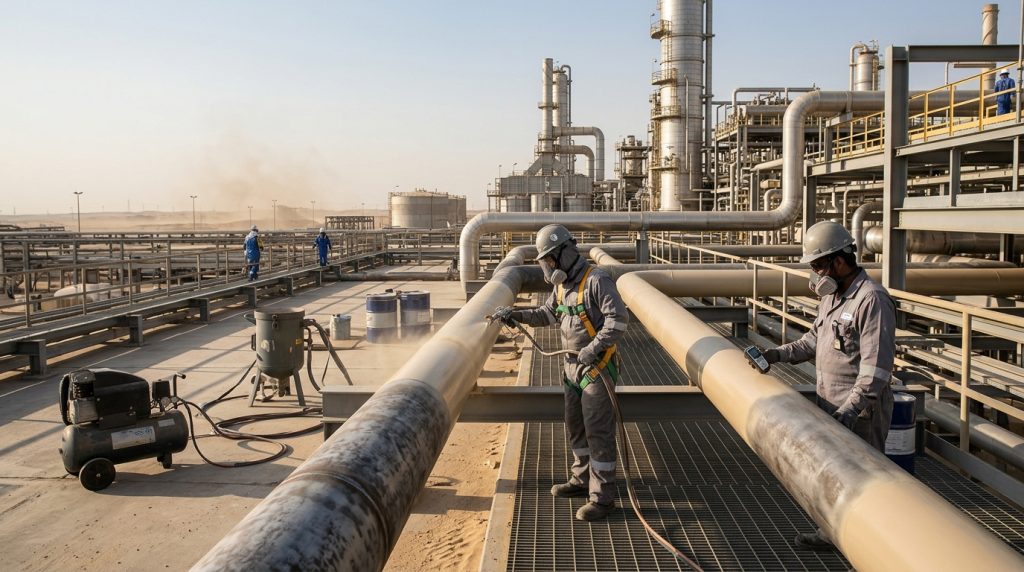
Industrial Coatings in Saudi Arabia: How Protective Coatings Prevent Corrosion and Extend Asset Life
Industrial coatings play a critical role in protecting steel structures, pipelines, storage tanks, industrial equipment, and other assets from corrosion, chemical exposure, moisture, abrasion, heat, and demanding operating conditions. In Saudi Arabia, selecting and applying the right protective coating system is particularly important because industrial assets can be exposed to intense heat, UV radiation, dust, humidity, saline environments, and aggressive chemicals.
For industrial operators, EPC contractors, and facility owners, a properly engineered coating system is more than a finishing layer. It is an important part of asset protection, maintenance planning, operational reliability, and long-term cost control.
What Are Industrial Coatings?
Industrial coatings are specialized protective materials applied to metal, concrete, steel, pipelines, tanks, equipment, and other industrial surfaces to protect them from environmental and operational damage.
Unlike conventional decorative paint, industrial protective coatings are selected according to the service environment, substrate, operating temperature, chemical exposure, mechanical conditions, required service life, and project specifications.
Depending on the application, industrial coating systems may provide resistance against corrosion, chemicals, abrasion, moisture, UV exposure, high temperatures, and other forms of deterioration.
Why Are Industrial Coatings Important in Saudi Arabia?
Saudi Arabia has a large and rapidly developing industrial base covering oil and gas, petrochemicals, energy, water and desalination, manufacturing, infrastructure, and major construction projects. These facilities depend on steel structures, pipelines, tanks, vessels, equipment, and other assets that must remain reliable throughout their operational life.
Industrial assets across the Kingdom can encounter severe environmental and operational conditions. Coastal facilities may experience saline moisture and humidity, while inland facilities can face extreme heat, dust, sand, and intense UV exposure. Industrial processes may also expose equipment to chemicals, elevated temperatures, moisture, and mechanical wear.
A correctly specified protective coating system helps create a barrier between the substrate and the environment, reducing the conditions that accelerate corrosion and surface deterioration.
Key Environmental Challenges for Industrial Assets
- High ambient temperatures
- Intense ultraviolet exposure
- Humidity and moisture
- Saline coastal environments
- Dust and airborne contaminants
- Chemical exposure
- Mechanical abrasion and impact
- Industrial pollutants
- Temperature fluctuations
How Do Industrial Coatings Prevent Corrosion?
Corrosion occurs when a metal surface reacts with its surrounding environment. For steel, exposure to moisture and oxygen can initiate electrochemical reactions that gradually deteriorate the substrate.
Protective coating systems work primarily by separating the metal surface from corrosive agents. Depending on the coating technology, the system may also provide additional chemical, mechanical, or electrochemical protection.
The effectiveness of corrosion protection depends on more than the coating product itself. Surface preparation, environmental conditions, application technique, coating thickness, curing, inspection, and maintenance all influence the final performance of the coating system.
Industrial Coating Protection Typically Depends on Four Factors
- Correct coating selection:
The coating system must match the substrate and service environment. - Proper surface preparation:
Rust, mill scale, old coatings, oil, dust, salts, and other contaminants must be properly addressed. - Controlled application:
Coatings must be applied according to the specified system, environmental conditions, and manufacturer requirements. - Inspection and quality control:
The completed coating should be inspected to verify the required quality and performance characteristics.
Types of Industrial Protective Coatings
There is no single coating system suitable for every industrial application. The appropriate system depends on the operating environment and the required level of protection.
Epoxy Coatings
Epoxy coatings are widely used for industrial protection because of their strong adhesion, durability, chemical resistance, and ability to provide high-build protective films. They can be used on a range of industrial assets when properly specified and applied.
Polyurethane Coatings
Polyurethane coatings are commonly used where weathering, UV resistance, appearance retention, and durability are important. They are frequently incorporated as part of multi-layer protective coating systems.
Zinc-Rich Primers
Zinc-rich primers can provide additional corrosion protection for steel through a combination of barrier and galvanic protection mechanisms, depending on the coating system and specification.
High-Performance Protective Coatings
Specialized high-performance coatings can be selected for demanding environments involving chemical exposure, immersion, abrasion, elevated temperatures, or other severe service conditions.
Fire-Resistant and Specialized Coating Systems
Certain industrial facilities require specialized coatings designed to provide fire protection or other specific performance characteristics. These systems must be selected and applied according to the applicable engineering requirements and approved specifications.
Industrial Coating Applications in Saudi Arabia
Industrial protective coatings are used across many sectors of the Saudi Arabian economy. Their applications range from large-scale energy infrastructure to industrial manufacturing and water facilities.
Oil and Gas Facilities
Oil and gas facilities contain extensive networks of pipelines, tanks, vessels, structural steel, process equipment, and supporting infrastructure. Protective coating systems can help control corrosion and preserve these assets under demanding operating conditions.
Petrochemical Plants
Petrochemical environments may expose assets to chemicals, elevated temperatures, moisture, and aggressive process conditions. Coating selection therefore needs to consider the specific chemical and operating environment.
Storage Tanks
Storage tanks may require different internal and external coating systems depending on the stored product, exposure conditions, temperature, and applicable project specifications.
Pipelines
Pipeline coating systems help protect steel surfaces from external corrosion and environmental exposure. The coating specification must be appropriate for the pipeline’s operating and installation conditions.
Structural Steel
Structural steel in industrial facilities can be exposed to atmospheric corrosion, humidity, chemicals, UV radiation, and other environmental factors. Protective coating systems help preserve structural integrity and extend maintenance intervals when properly designed and maintained.
Industrial Equipment
Equipment, vessels, skids, machinery, and fabricated components may require specialized protective coatings based on their operating environment, material, temperature, chemical exposure, and mechanical conditions.
Why Surface Preparation Is Critical Before Industrial Painting
One of the most important stages of an industrial coating project takes place before the coating is applied: surface preparation.
A coating can only perform as intended when it has an appropriate surface to bond to. Rust, mill scale, old coating, grease, salts, dust, moisture, and other contaminants can compromise adhesion and accelerate premature coating failure.
Abrasive Blasting
Abrasive blasting is a widely used surface preparation method for industrial coating applications. It can remove corrosion products, existing coatings, mill scale, and contaminants while producing an appropriate surface profile for the specified coating system.
Other Surface Preparation Methods
Depending on the substrate and project requirements, surface preparation may involve abrasive blasting, water jetting, mechanical preparation, power-tool cleaning, solvent cleaning, or other approved methods.
The correct preparation method should always be determined by the coating specification, substrate condition, project requirements, and service environment.
What Determines the Right Industrial Coating System?
Choosing an industrial coating should never be based solely on the product name or initial purchase price. The coating system should be engineered around the asset and the conditions in which it will operate.
Important Selection Factors
- Substrate: steel, galvanized steel, concrete, or another material.
- Service environment: atmospheric, marine, immersion, chemical, or industrial.
- Temperature: normal and maximum operating temperatures.
- Chemical exposure: type and concentration of chemicals.
- Mechanical exposure: abrasion, impact, vibration, or wear.
- Expected service life: required protection period and maintenance strategy.
- Surface condition: existing corrosion, old coating, contamination, and substrate profile.
- Application conditions: temperature, humidity, dew point, ventilation, access, and site conditions.
- Project specification: applicable client, engineering, quality, safety, and coating requirements.
Industrial Coating Application: From Surface Preparation to Final Inspection
A professional industrial coating project requires a controlled process rather than simply applying paint to a surface.
1. Asset and Surface Assessment
The project begins with an assessment of the substrate, existing coating condition, corrosion level, operating environment, access requirements, and project specifications.
2. Surface Preparation
The surface is prepared using the specified cleaning and preparation method. The objective is to achieve the required cleanliness and surface profile before coating application.
3. Primer Application
Where required, the specified primer is applied to establish the foundation of the protective coating system.
4. Intermediate and Top Coats
Additional coating layers are applied according to the approved coating system. Each layer must be compatible with the previous layer and applied under suitable environmental conditions.
5. Inspection and Quality Control
Inspection may include visual examination, environmental monitoring, dry film thickness measurements, adhesion testing, holiday detection, and other tests specified for the project.
6. Final Documentation
Professional coating projects should maintain appropriate quality records, inspection results, material information, application records, and other project documentation required by the client or applicable specification.
Common Industrial Coating Problems and Their Causes
Premature coating failure can increase maintenance requirements and expose industrial assets to accelerated deterioration. Understanding common failure mechanisms is therefore essential.
Poor Adhesion
Poor adhesion can result from inadequate surface preparation, contamination, incorrect application conditions, incompatible coating layers, or other application-related problems.
Blistering
Blistering can occur when moisture, solvents, gases, or other factors become trapped beneath or within the coating system.
Premature Corrosion
Corrosion beneath or through a coating can be associated with inadequate surface preparation, coating defects, insufficient film thickness, environmental exposure, mechanical damage, or an unsuitable coating system.
Peeling and Delamination
Peeling or delamination may indicate inadequate adhesion, contamination, incompatible layers, incorrect curing, excessive coating thickness, or other application problems.
Cracking
Cracking can result from substrate movement, excessive coating thickness, aging, thermal stress, incompatible layers, or coating-system limitations.
How Professional Industrial Coating Services Reduce Maintenance Costs
Industrial coating should be considered as part of an asset-management strategy rather than simply a painting expense.
When an appropriate coating system is combined with proper surface preparation, controlled application, inspection, and planned maintenance, industrial operators can reduce the risk of premature deterioration and improve the long-term protection of valuable assets.
The economic value of a coating system therefore extends beyond the material and application cost. It can also involve reduced unplanned maintenance, fewer interruptions, improved asset reliability, and better preservation of industrial infrastructure.
Industrial Coatings and Saudi Arabia’s Industrial Growth
Saudi Arabia’s expanding industrial and infrastructure activity continues to create demand for durable surface protection. Oil and gas, petrochemicals, energy, water infrastructure, manufacturing, construction, and major development projects all depend on assets that require reliable protection against corrosion and environmental deterioration.
The Saudi industrial coatings market is also supported by continued investment in industrial development and infrastructure. Recent market research places significant demand in sectors such as oil and gas, construction, and industrial infrastructure, with the Eastern Province representing an important industrial center.
For project owners and contractors, this makes coating engineering, surface preparation, application quality, inspection, and maintenance increasingly important components of industrial asset management.
Why Choose FACC for Industrial Coating Solutions?
FACC provides industrial support and coating solutions designed around the requirements of demanding industrial environments in Saudi Arabia.
Our approach focuses on understanding the asset, service environment, project requirements, surface condition, coating specification, application conditions, and quality requirements before execution.
From surface preparation and protective coating application to industrial maintenance support, FACC works to deliver practical solutions that help clients protect their assets and maintain operational reliability.
Our Industrial Coating Approach
- Project and surface assessment
- Surface preparation
- Abrasive blasting and cleaning
- Industrial painting and protective coating application
- Multi-layer coating systems
- Quality inspection and control
- Maintenance coating and restoration
- Industrial project support
Every industrial coating project should be approached according to its specific technical requirements rather than using a one-size-fits-all solution.
Frequently Asked Questions About Industrial Coatings in Saudi Arabia
What are industrial coatings used for?
Industrial coatings are used to protect steel, pipelines, tanks, equipment, concrete, and other industrial assets from corrosion, chemicals, moisture, abrasion, UV exposure, heat, and environmental deterioration.
Why are protective coatings important in Saudi Arabia?
Protective coatings are important because industrial assets in Saudi Arabia can experience high temperatures, intense UV exposure, dust, humidity, saline environments, chemicals, and demanding operating conditions. A properly selected coating system helps protect exposed surfaces from deterioration.
What is the best industrial coating for corrosion protection?
There is no single best coating for every application. The appropriate system depends on the substrate, service environment, temperature, chemical exposure, mechanical conditions, required service life, and project specification.
Why is surface preparation important before industrial painting?
Surface preparation removes contaminants and prepares the substrate for coating application. Proper preparation improves coating adhesion and helps the protective system achieve its intended performance.
What is abrasive blasting?
Abrasive blasting is a surface preparation process that uses an abrasive medium to remove rust, mill scale, existing coatings, and contaminants while creating a surface profile suitable for the specified coating system.
Which industrial assets require protective coatings?
Protective coatings can be used on structural steel, pipelines, storage tanks, vessels, process equipment, machinery, fabricated components, industrial buildings, and other assets depending on their material and operating environment.
How long do industrial coatings last?
Coating service life varies significantly depending on the coating system, substrate preparation, environmental exposure, application quality, operating conditions, and maintenance program. A coating specification should therefore define the required performance and expected service conditions.
How can I choose an industrial coating contractor in Saudi Arabia?
Consider the contractor’s industrial experience, technical capability, surface preparation methods, coating application expertise, inspection and quality-control procedures, safety practices, workforce competency, project references, and ability to meet the applicable project specifications.
Need Industrial Coating Services in Saudi Arabia?
Protect your industrial assets with a coating strategy designed around your operating environment and project requirements. Contact FACC to discuss your industrial coating, surface preparation, corrosion protection, or maintenance requirements.